
DHS News & History
TSA 25th Anniversary: 25 Years of Aviation Security

Oct
25 Years of the Transportation Security Administration: The Day That Changed American Air Travel
Before September 11: A Different Era of American Air Travel
As TSA marks a quarter century of service, we recognize the professionals who have accepted that responsibility—and honor the enduring commitment to a safer, more secure transportation system.
For Americans who remember flying before September 11, 2001, the experience can seem almost unrecognizable today.
Family members could accompany travelers to the departure gate. Friends and loved ones gathered at terminal windows to watch aircraft take off. Airport security checkpoints existed, but the procedures were generally less intrusive, and many of the restrictions familiar to modern travelers had yet to be introduced.
Shoes usually stayed on. Liquids were not subject to today’s familiar restrictions. Boarding an aircraft involved comparatively few of the security procedures that have since become routine.
Yet the often-repeated suggestion that America’s airports had little or no security before September 11 is historically inaccurate.
By the early 1970s, a wave of aircraft hijackings had already prompted the federal government to establish nationwide passenger screening requirements. Beginning January 5, 1973, airlines were required to screen passengers and carry-on baggage, making metal detectors and X-ray equipment standard features of commercial air travel.
The Federal Aviation Administration (FAA) established and enforced security regulations, while airlines generally employed private contractors to operate passenger checkpoints.
By 2001, aviation security was shaped by two principal concerns: conventional hijackings, typically involving demands and negotiations, and aircraft bombings. The 1988 destruction of Pan Am Flight 103 over Lockerbie, Scotland, had demonstrated the catastrophic danger posed by explosives concealed aboard commercial aircraft.
The security system was designed around these known threats.
Its underlying assumptions reflected decades of experience. Hijackers traditionally sought to divert aircraft, demand political concessions, negotiate prisoner releases, or secure ransom payments. The prevailing response emphasized containing the incident, preserving lives, and finding a negotiated resolution.
Cockpit doors were intended to remain closed and locked during flight, but they were not designed to withstand a determined assault of the kind that would occur on September 11.
Security standards also varied in their implementation. Screening personnel frequently worked for private companies operating under airline contracts, with differences in compensation, training, and workforce stability.
The rules governing what passengers could carry aboard aircraft were also substantially different.
Under FAA regulations in effect before September 11, knives with blades shorter than four inches were not expressly prohibited. Airline checkpoint guidance generally permitted small pocketknives but classified box cutters as restricted items.
That distinction was not always straightforward in practice.
The 9/11 Commission later documented that checkpoint screening procedures did not adequately distinguish between certain small cutting instruments, and that metal detectors were primarily designed to identify larger metallic weapons.
Even when small knives were detected, they were frequently permitted through screening.
These vulnerabilities were part of a broader system whose limitations had been identified in federal evaluations before the attacks.
By the summer of 2001, American commercial aviation had become a remarkably efficient transportation network, moving millions of passengers through airports across the country.
But the system’s greatest vulnerability was not simply the equipment at its checkpoints.
It was the nature of the attack it had not adequately anticipated.

September 11, 2001: The Day Everything Changed
On the morning of Tuesday, September 11, 2001, nineteen terrorists associated with al-Qaeda boarded four commercial passenger aircraft departing from airports in Boston, Newark, and the Washington, D.C., area.
All nineteen passed through the aviation security procedures in place at the time.
The attacks exposed critical failures extending well beyond individual checkpoints. Intelligence information had not been effectively integrated into aviation security decisions. Passenger prescreening programs were designed around earlier threat models, and many of the security measures intended to protect aircraft were inadequate against coordinated suicide hijackings.
The terrorists exploited those weaknesses with devastating consequences.
American Airlines Flight 11 struck the North Tower of the World Trade Center at 8:46 a.m.
United Airlines Flight 175 struck the South Tower at 9:03 a.m.
American Airlines Flight 77 struck the Pentagon at 9:37 a.m.
On United Airlines Flight 93, passengers and crew resisted the hijackers. The aircraft crashed near Shanksville, Pennsylvania, at 10:03 a.m., before reaching its intended target.
The attacks claimed the lives of 2,977 victims.
As the scope of the attacks became clear, the FAA initiated an unprecedented emergency response.
At 9:25 a.m., the agency ordered a nationwide halt to civilian aircraft departures. At approximately 9:45 a.m., it directed aircraft already in American airspace to land at the nearest suitable airport as soon as practical.
It was the first unplanned shutdown of United States airspace.
The images of that morning remain indelible: smoke rising from the towers, the damage at the Pentagon, the devastation in Pennsylvania, and the extraordinary courage of first responders and ordinary citizens.
For the aviation industry, September 11 represented something unprecedented.
Commercial aircraft had been transformed from transportation vehicles into weapons of mass destruction.
The assumptions that had guided decades of aviation security planning were shattered in a matter of hours.
The United States faced an urgent question: How could an open, interconnected transportation system be protected against threats fundamentally different from those it had been built to confront?
The Immediate Aftermath: Rebuilding Security and Restoring Confidence
In the days following September 11, American aviation began operating under extraordinary new security measures.
Airports reopened gradually, with heightened law enforcement presence, more restrictive access to departure areas, and intensified passenger and baggage screening.
The general public could no longer move freely through secure departure areas as it had before the attacks. Restrictions on items permitted aboard aircraft became more stringent, and changes to aircraft security procedures were introduced.
Federal leaders also confronted a larger structural question.
For decades, the federal government had regulated aviation security while airlines and their contractors carried out much of the screening.
The attacks demonstrated the need for a more unified national system, one with centralized accountability, standardized training, federal oversight, and the ability to respond to emerging intelligence.
Congress moved rapidly.
On November 19, 2001, just 69 days after the attacks, President George W. Bush signed the Aviation and Transportation Security Act into law.
The legislation established the Transportation Security Administration, initially within the Department of Transportation.
Its mission extended beyond airport checkpoints. TSA was charged with protecting the nation’s transportation systems, including aviation and other modes of passenger and freight transportation.
The new agency faced an immense undertaking: building a federal organization while simultaneously transforming the security operations of an aviation industry that needed to continue functioning.
The legislation required a transition to federal passenger screening at commercial airports within one year.
In less than twelve months, TSA undertook one of the most ambitious federal workforce mobilizations of its era, establishing a new screening organization and deploying tens of thousands of federal personnel to airports across the country.
By the November 19, 2002, deadline, the transition to a predominantly federal passenger-screening workforce had been accomplished. The agency was simultaneously expanding checked-baggage explosives screening and implementing new operating standards.
The undertaking was remarkable in its scale and speed.
In March 2003, TSA became part of the newly established Department of Homeland Security, joining a broader federal effort to coordinate the nation’s security and emergency preparedness responsibilities.
What began as an emergency response to a national tragedy was becoming a permanent institution.
Two Decades of Adaptation and Innovation
The creation of TSA was only the beginning.
Threats to civil aviation continued to evolve, requiring security procedures, technologies, and intelligence capabilities to evolve alongside them.
Following the attempted shoe bombing of an international flight in December 2001, footwear screening became an increasingly important part of airport security.
The discovery of a plot involving liquid explosives in 2006 prompted new restrictions on liquids, aerosols, and gels carried into aircraft cabins.
Attempts to conceal explosive devices in clothing and personal belongings accelerated the deployment of advanced imaging technologies capable of detecting threats that conventional metal detectors might miss.
Checked-baggage screening expanded through explosive detection systems and related technologies. Reinforced cockpit doors, enhanced passenger vetting, expanded air marshal capabilities, and improved coordination among federal agencies added further layers of protection.
The objective was no longer to rely upon a single checkpoint or procedure.
It was to establish multiple, mutually reinforcing security measures capable of detecting, deterring, and responding to different threats.
Over time, TSA also pursued ways to improve the passenger experience without abandoning its security mission.
The introduction of TSA PreCheck in 2011, followed by the direct-enrollment program in 2013, helped establish a more risk-based approach to screening eligible travelers.
Meanwhile, technology continued to transform airport operations.
Three-dimensional computed tomography scanners, advanced imaging systems, explosive trace detection, and electronic identity verification tools have improved the ways security personnel examine baggage, evaluate potential threats, and verify traveler credentials.
Some procedures introduced in response to earlier threats have also been reconsidered.
For example, routine shoe removal became a familiar part of airport screening for many travelers beginning in 2006. In July 2025, the Department of Homeland Security announced the end of the general shoes-off requirement at domestic TSA checkpoints, reflecting changes in screening technology and security assessments. Footwear may still be subject to additional screening when necessary.
This evolution illustrates an important principle: effective security is not necessarily defined by retaining every restriction indefinitely, but by continually evaluating threats, technologies, and the effectiveness of existing measures.
The agency’s responsibilities also extend beyond commercial aviation. TSA works with public- and private-sector partners to strengthen security across passenger rail, mass transit, pipelines, freight rail, and other transportation infrastructure.
The underlying principle remains consistent: transportation security must evolve as quickly as the threats it seeks to prevent.
Today: Twenty-Five Years of Service
Today, the Transportation Security Administration occupies a central role in American transportation security.
Each day, TSA personnel screen millions of travelers moving through the nation’s commercial airports. Behind the visible checkpoints stands a larger network of explosives specialists, canine teams, inspectors, federal air marshals, intelligence professionals, trainers, technology specialists, and administrative personnel.
Their work requires a difficult balance.
The American transportation system must remain accessible and efficient, allowing people and commerce to move freely. At the same time, it must be protected against threats that are increasingly sophisticated, adaptive, and unpredictable.
Security procedures have not been without controversy. Travelers, lawmakers, and oversight organizations have raised legitimate questions over the years about privacy, screening effectiveness, passenger experience, workforce conditions, and the costs of maintaining a vast federal security system.
These questions remain important. Effective security requires not only vigilance and capability, but also accountability, public confidence, and continued examination of whether existing practices serve their intended purpose.
Yet the historical significance of TSA’s creation is unmistakable.
Before September 11, aviation security was governed by a system of federal regulation and largely private screening operations, reflecting a different understanding of the dangers commercial aviation faced.
In the years that followed, the United States built a nationwide federal transportation security organization, established new layers of defense, and developed capabilities that would have been difficult to imagine at the beginning of the century.
The transformation has been profound.
And behind that transformation are the men and women who have carried out the mission, often in circumstances where their greatest accomplishment is that nothing happens at all.
Honoring the Mission, Remembering the Reason
November 19, 2026, marks the 25th anniversary of the Transportation Security Administration.
It is an occasion to recognize the agency’s institutional history, the extraordinary changes in transportation security over the past quarter century, and the contributions of generations of TSA personnel.
It is also an occasion for remembrance.
The agency’s founding cannot be separated from the 2,977 victims of September 11, 2001, or from the courage demonstrated by passengers, crew members, emergency responders, and countless others on that day.
Twenty-five years later, the responsibility born from those events remains.
To protect the freedom of movement that connects our communities, supports our economy, reunites our families, and enables Americans to explore the world.
As TSA marks a quarter century of service, we recognize the professionals who have accepted that responsibility—and honor the enduring commitment to a safer, more secure transportation system.
Commemorating 25 Years of TSA
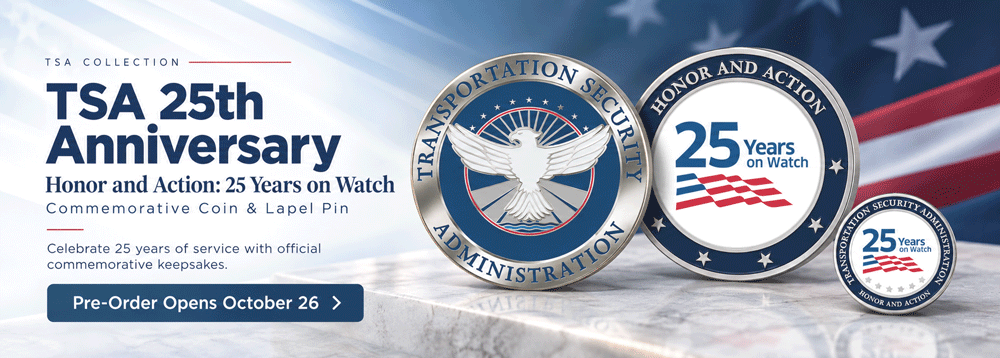
In recognition of this significant milestone, the DHS Gift Shop is proud to offer commemorative items celebrating the Transportation Security Administration’s 25th anniversary.
Our anniversary collection includes specially designed coins and pins honoring the agency’s history, mission, and the dedicated professionals who have served over the past quarter century.
These commemoratives offer a lasting way to recognize individual service, celebrate the agency’s legacy, and mark an important chapter in American transportation history.
Explore the TSA 25th Anniversary Collection at the DHS Gift Shop.
Historical Sources and Further Reading
- National Commission on Terrorist Attacks Upon the United States. The 9/11 Commission Report (2004). Especially Chapter 3, concerning the pre-September 11 aviation security system.
https://www.9-11commission.gov/report/ - Federal Aviation Administration. FAA Historical Chronology, 1997–2020. Documentation of the September 11 national ground stop, airspace shutdown, and subsequent aviation developments.
https://www.faa.gov/sites/faa.gov/files/about/history/1997-2020_FAA_Historical_Chronology.pdf - United States Congress. Aviation and Transportation Security Act, Public Law 107-71, November 19, 2001.
https://www.govinfo.gov/app/details/PLAW-107publ71 - Transportation Security Administration. TSA Historical Timeline. Agency formation, security milestones, programs, and technology.
https://www.tsa.gov/timeline - Department of Homeland Security / Transportation Security Administration. DHS to End “Shoes-Off” Travel Policy, July 8, 2025.
https://www.tsa.gov/news/press/releases